
Kit List
- Tap to view our recommendations
A robust, breathable and waterproof jacket that fits over several layers. It should have a permanently attached hood that is large enough to go over a helmet.
Robust, breathable and waterproof, ideally with long side zips (for big boots), crampon patches on the ankle and braces.
A large warm jacket to wear whilst stationary is useful. Synthetic insulation is better than down in the UK due to our damp climate.
A couple of lightweight thermal tops, short or long sleeved. Should be of a synthetic material and not cotton.
A couple of mid-weight layers, ideally fleece. This gives more flexibility for managing your temperature rather than one thick layer.
Softshell trousers, if possible, as they are good at blocking out wind. If you have thermal trousers bring them too, as they can be great on cold days.
A fleece or wool hat suitable to be worn under a helmet – no bobbles. A neck gaiter is also useful.
At least two pairs are essential. They should be dexterous enough that you can put crampons on whilst wearing them.
A thin fleece pair is useful for wearing whilst approaching the hills.
Nice thick warm socks. Some people like a thin liner pair as well.
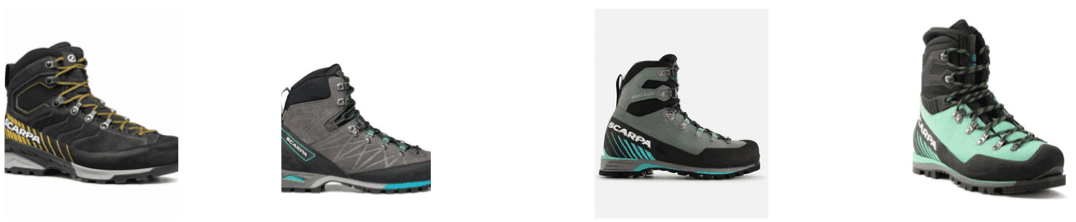
We have an extensive stores range of boots for you to try and we can discuss different boots during the course so you know what to look for. However, if you are bringing your own then you’ll need either B2 or B3 boots. It’s worth going to a specialist shop so you can try on several pairs to ensure they fit well. When buying winter boots it’s worth investing in a good pair as they will last you a long time.
Winter footwear needs to deal with a very different environment than our summer boots so what we wear on our feet is very different. Our boots are heavier, so they are durable and warm. They are also stiffer so we can kick steps in hard snow and wear crampons.
Boots have a B rating, from B0 to B3. The four boots below are rated B0, B1, B2 and B3. The rating relates to how stiff the boot is and their crampon compatibility. The boot of
the left is rated B0, is flexible and not designed to take a crampon. The boot on the right is rated B3, is rigid and is designed for winter climbing.
In general winter walking and mountaineering is generally done in a B2 boot and winter climbing in a B3. Good quality leather/synthetic boots are best. Plastic boots are warmer but are more cumbersome, and the warmth offered by high altitude boots is simply not necessary. Larger-sized boots will flex more than smaller sizes so if you have large feet, then go for a more rigid boot. You will be less likely to slip out of your crampons.
Our advice is to buy a quality boot that fits your foot well. Be careful to make sure they are not too small as constricted feet get cold. It is well worth the extra expense and a quality boot will last many years. Be prepared to spend some time ensuring the size and fit is correct and take the time to visit a mountaineering shop. It is important to wear your boots in and it can be advisable to initially place tape on your heels and any ‘hot spots’. Spend time walking around locally, even around the house, before attempting anything more adventurous. Most staff wear either one thick sock or a thin and thick combination. Buy good quality socks, and bring several pairs. For most winter mountaineering courses, our staff use footwear from the excellent range by Scarpa.
A walking or mountaineering ice axe. A length of 55–60cm is usually suitable.
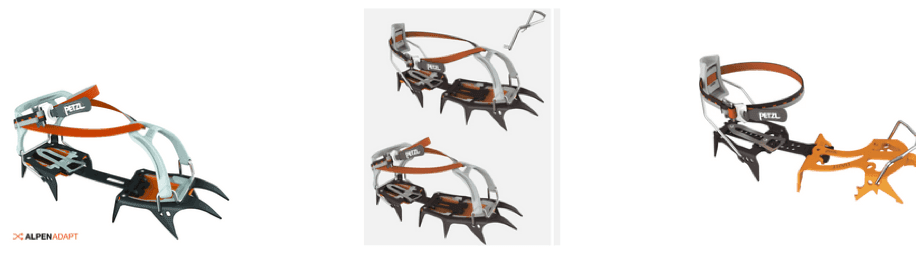
We do have crampons in stores for you to try and we can discuss crampons as part of the course, so you know what to buy for your winter adventures. However, if you are bringing your own then ensure they fit your boots. The Petzl Vasak is a good example of a mountaineering crampon as it has 12 points and anti-balling plates.
Crampons are also rated from C1 to C3 and, like boots, relate to stiffness, with C1 being the most flexible and C3 being the stiffest. Again, the crampons below go from C1 to C3.
As a rule, a C2 crampon such as the Petzl Vasak (shown in the middle) would be used for winter walking and mountaineering and a C3 crampon such as the Petzl Lynx for climbing. However, for starting winter climbing C2 crampons will suffice as you don’t need specialist climbing crampons. Climbing crampons are only necessary from Grade IV.
Crampons and boots need to be matched. B2 boots can be used with crampons rated B2 or lower. C3 boots can be used with crampons rated C3 or lower. But B2 boots cannot be used with C3 crampons as the crampon may come off due to the boot not being stiff enough. It’s best to have your boots with you when you buy your crampons to ensure they fit well together. Take your boot with you when you buy your crampons and fit them to the boot in the shop to ensure a good fit. Buy a 12-point crampon with a general mountaineering configuration with anti-balling plates. Be aware that with small feet (size 6 or under), certain types of crampons are best avoided – get crampons fitted by the shop.
Extremely useful to prevent snow and scree entering your boots and to help keep your feet warm.
A tough nylon bag to protect the contents of your rucksack from sharp points.
A helmet suitable for winter mountaineering and climbing.
An essential item for winter conditions. A budget pair with double-layer lenses is sufficient.
Winter days require carrying more equipment than summer. Ensure your rucksack has a supportive waistbelt.
Almost no rucksacks are waterproof. Use a waterproof liner, large dry bag, several smaller dry bags, or a strong rubble bag.
A small flask (½ to ¾ litre) and a similar-sized water bottle. Hydration systems with tubes rarely work well in winter.
OS Explorer OL17 Snowdon & Conwy Valley (1:25,000). Laminated maps are recommended.
A quality compass suitable for mountain navigation.
A method of protecting your mobile phone from the elements is essential.
A simple plastic whistle is a useful piece of emergency equipment.
A reliable headtorch with spare batteries. Invest in durability, brightness and battery life.
Include blister plasters and any personal medication you may need.
High-energy food items sealed in a bag, such as chocolate or muesli bars.
Protection from UV radiation and wind.
Essential in sunny conditions due to snow reflection.
Useful below the snow line and on low-angle snow slopes. Poles should be collapsible for storage inside your rucksack.