What is on a Plas y Brenin Climbing Rack?
We sat down with senior instructor, Pete Herd, to chat through what’s on our “standard” rack at Plas y Brenin, what tweaks you might choose to make, and what to consider as you build your own rack.
We are proud to work with DMM, based in North Wales, UK. Our team relies heavily on DMM’s gear, designed and manufactured in the UK.
Personal & Essentials
Before adding lead protection, every climber needs a core set of personal gear attached to their harness for belaying, seconding and abseiling:
- Belay Device & Locking Carabiner: A standard belay device with a guide mode(such as a DMM Pivot) paired with an HMS locking carabiner. Our team will usually carry two more locking carabiners: one to attach to the anchor with and one to operate guide mode.
- Nut Key DMM Nutbuster: Crucial personal kit carried by the second to extract gear.
- 120cm Sling & 2 Prusiks: Carried on locking carabiners and used for personal security and descending safely using a friction hitch.
“Most traditional belay devices have a “guide” mode – this is a really useful feature but requires skill and understanding to use safely and effectively” – Pete Herd
The “Standard” Rack
“For leading, this size of rack would get you up most single-pitch trad climbs, give or take a few extra bits.” – Pete Herd.
Nuts
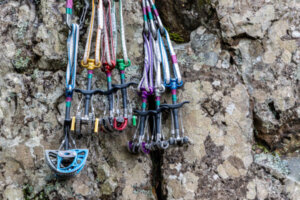
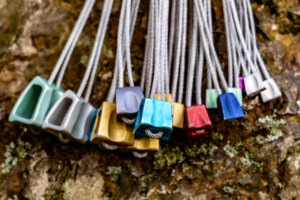
- Double Set of Standard nuts (Sizes 1–11): Having two sets of nuts allows you to place multiple pieces of the same size. Our nuts are racked across three snapgates, organised by size
- Instructor Tip: “We tend not to carry doubles of the largest nuts (Sizes 10 and 11). Large nuts are heavy and bulky on the harness without providing enough extra utility to justify the weight.”
Cams
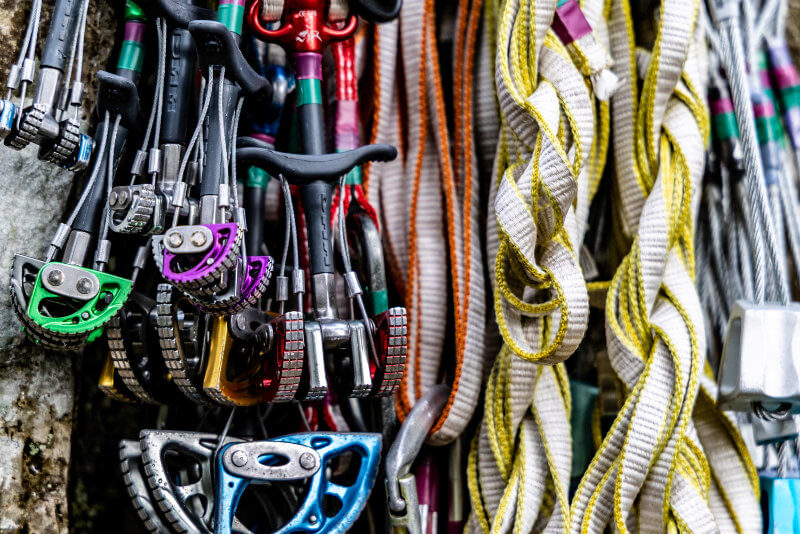
- Full Range Single Set of Cams: Ranging from small (e.g. small blue DMM Dragon) up to large (big blue).
- Instructor Tip: “If you are able, a second set of some mid-sized cams can be a worthwhile addition for longer routes.
“Make an effort to work on nut craft rather than solely relying on cams. This is especially important in soft and/or low friction rock types like limestone, sandstone and slate where cam placements that appear good can fail” – Pete Herd
Quickdraws & Extension Runners
- Fixed-Length Quickdraws: 6-8 x mid-length quickdraws for straightforward inline protection.
- Extendable Alpine Quickdraws: 4-6 x 60cm Dyneema slings racked with lightweight snapgates that can be used folded short or extended long.
“I prioritize longer quickdraws over loads of short ones — they’re super versatile when you want to extend runners that are ‘offline’ or under roofs. Extendable alpine-style quickdraws are really handy in that respect.” – Pete Herd
Anchors & Rigging
- 120cm Slings: 3 to 5 x 120cm Dyneema slings racked on lightweight screwgate carabiners or snapgates for natural threads, spikes, and building equalised belay anchors.
- Large Screwgates: 1 or 2 HMS locking carabiners for use at the anchor.
Extras
When stepping up to longer pitches, adventurous routes, or pushing into mid-to-higher grades with complex or marginal protection, Pete recommends adding specialized gear to the harness:
- Offset nuts (DMM Alloy Offsets / Peenuts): These tapered nuts can fit flared or irregular cracks and peg scars where standard nuts won’t.
- IMPs: Essential additions when heading onto routes with scarce or marginal protection options.
- Micro Cams (DMM Dragonflys): Ranging from tiny micro sizes up to narrow finger sizes for thin cracks, pockets and peg scars.
- Extra Mid-Size Cams: A second set of cams, especially in the finger-to-small-hand size can be really useful on big pitches.
At this point, you’re way beyond building your first rack! Don’t feel you have to get everything at once! – Pete Herd.
How to Build Your First Trad Rack
Pete’s Advice for Beginners
If you’re starting out and building your very first trad rack, these few points will help you build up a really solid starting point:
- Prioritize Nut Craft First: Don’t rely solely on cams. Building solid nut craft—learning how to seat nuts securely—is a foundational skill for safe trad climbing.
- Invest in Cams Wisely: Cams are an investment but worth every penny as you develop your rack. Aim to build up a full set over time.
- Choose Extendable Quickdraws over Short Draws: Short sport – style quickdraws could cause severe rope drag on wandering trad routes. Mid length trad quickdraws and 60cm extendable alpine quickdraws are more versatile and effective at extending runners and reducing rope drag.
- Keep Anchors Simple: Using a few 120cm slings to equilise nearby pieces and the rope to these points will work in most scenarios.
Looking to build your rack?
Here are some useful links to get you started:
Wallnuts and Cams
- https://dmmwales.com/collections/trad-climbing/products/wallnuts
- https://dmmwales.com/collections/trad-climbing/products/dragon-cam-set-custom-text
Slings and Personal Gear
- https://dmmwales.com/collections/trad-climbing/products/dynatec-11mm
- https://dmmwales.com/collections/trad-climbing/products/pivot-phantom-hms-set-custom-text
- https://dmmwales.com/collections/sport-climbing/products/mantis
- https://dmmwales.com/collections/trad-climbing/products/shadow-locking
Quickdraws
- https://dmmwales.com/collections/trad-climbing/products/aether-quickdraw?variant=44565239136515
- https://dmmwales.com/collections/trad-climbing/products/spectre-2-quickdraw?variant=43720752660739
Offsets, IMPs, and Microcams
- https://dmmwales.com/collections/trad-climbing/products/hb-alloy-offsets
- https://dmmwales.com/collections/trad-climbing/products/dragonfly-cam
- https://dmmwales.com/collections/trad-climbing/products/i-m-p-brass-nuts